
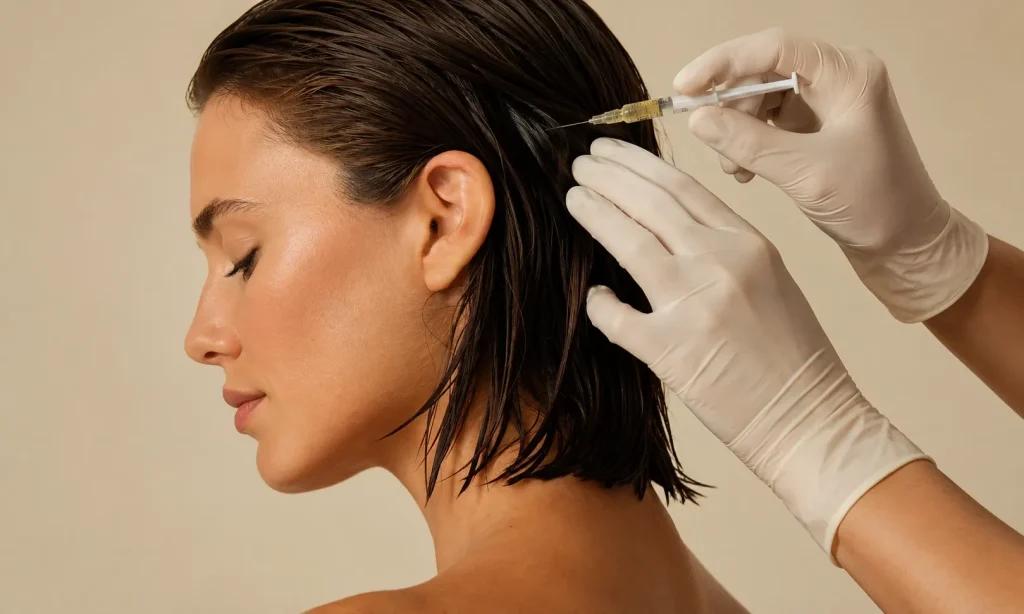
What Is Hair Filler?
Hair filler, also known as injectable hair filler, is a regenerative scalp treatment designed to improve the condition of weakened hair follicles rather than simply masking hair loss.
The treatment involves injecting a sterile solution into the scalp using multiple microinjections. These injections deliver biologically active ingredients directly around the hair follicles, where they may help create a healthier environment for hair growth.
Unlike cosmetic fillers used for facial contouring, hair fillers do not increase scalp volume. Instead, they focus on improving follicular nutrition, supporting cellular repair, and maintaining scalp hydration.
Most modern hair filler products contain a combination of:
- Stabilized hyaluronic acid
- Biomimetic peptides
- Amino acids
- Vitamins
- Minerals
- Antioxidants
- Growth-supportive compounds
The goal is to strengthen miniaturized follicles, improve hair shaft quality, reduce excessive shedding, and encourage healthier hair growth over time.
Hair filler is considered a non-surgical procedure with minimal downtime, making it attractive for patients seeking early intervention before extensive hair loss develops.
Does Hair Filler Help Hair Growth?
Yes—but it is important to understand how it works.
Hair filler does not create new hair follicles. Humans are born with a fixed number of follicles, and once a follicle is permanently destroyed, injectable treatments cannot regenerate it.
Instead, hair filler aims to improve the biological activity of existing follicles by:
- Supporting scalp hydration
- Enhancing the follicular microenvironment
- Reducing inflammation around hair follicles
- Providing essential nutrients
- Stimulating cellular metabolism
- Supporting the normal hair growth cycle
Patients with dormant but living follicles often experience better results than those with advanced baldness.
Clinical experience suggests that hair filler may help:
- Reduce excessive hair shedding
- Increase hair density
- Improve hair thickness
- Enhance hair strength
- Improve scalp quality
- Reduce hair breakage
Visible improvements usually appear gradually over several weeks because hair grows in natural cycles.
It is important to remember that outcomes vary depending on:
- Age
- Genetics
- Hormonal factors
- Cause of hair loss
- Overall scalp health
- Treatment consistency
Hair filler should be viewed as part of a comprehensive hair restoration plan rather than a permanent cure for all types of hair loss.
Best Hair Filler Clinic
Choosing the right clinic is one of the most important factors affecting both treatment safety and clinical outcomes.
Hair filler injections require a detailed understanding of scalp anatomy, hair growth biology, injection depth, sterile technique, and accurate diagnosis of the underlying cause of hair loss.
A qualified physician should perform a comprehensive consultation before treatment, evaluating:
- Type of hair loss
- Medical history
- Hormonal factors
- Previous hair treatments
- Scalp condition
- Hair density
- Patient expectations
Rather than applying the same protocol to every patient, experienced practitioners customize the treatment plan according to individual needs.
Additional factors that distinguish a high-quality clinic include:
- Use of authentic, approved products
- Strict infection-control protocols
- Personalized treatment planning
- Transparent patient education
- Comprehensive follow-up care
For patients seeking Hair Filler Injection in Dubai, Dr. Ali Clinic provides individualized hair restoration treatments using authentic products and evidence-based protocols. Each patient undergoes a detailed scalp assessment to determine whether hair filler is the most appropriate option or whether it should be combined with complementary treatments such as PRP or mesotherapy for optimal results.
How Is Hair Filler Injected?
Hair filler treatment begins with a consultation to determine whether the patient is a suitable candidate.
After cleaning and disinfecting the scalp, the physician identifies the treatment areas based on the pattern of hair thinning.
The procedure typically involves multiple superficial injections across the affected scalp using a very fine needle.
The treatment generally follows these steps:
- Medical evaluation
- Scalp examination
- Photographic documentation
- Cleansing and disinfection
- Optional topical anesthetic
- Multiple microinjections
- Gentle post-treatment care instructions
The injections are usually placed approximately 1–2 cm apart to achieve even distribution of the product throughout the treatment area.
Most sessions take between 20 and 40 minutes, depending on the size of the scalp being treated.
Patients commonly describe the discomfort as mild and temporary.
Immediately after treatment, small bumps, mild redness, or slight tenderness may occur but usually resolve within a short period.
Most individuals return to their normal daily activities the same day.
Hair Filler Ingredients
The effectiveness of hair filler depends largely on its formulation. Modern products combine multiple active ingredients that work together to support scalp health and hair follicle function.
|
Ingredient |
Primary Function |
| Stabilized Hyaluronic Acid |
Maintains scalp hydration and supports tissue repair |
|
Biomimetic Peptides |
Help regulate follicular activity and cellular signaling |
| Amino Acids |
Building blocks for keratin production |
|
Vitamins |
Support healthy cellular metabolism |
| Minerals |
Assist enzymatic reactions important for hair growth |
|
Antioxidants |
Help reduce oxidative stress around follicles |
| Growth-supporting compounds |
Promote healthier follicular function |
Each ingredient contributes differently, which is why product selection should always be based on the patient’s clinical condition rather than marketing claims alone.
What Is a Hair Filler Cocktail and What Does It Contain?
The term Hair Filler Cocktail refers to the carefully balanced mixture of active ingredients included in injectable hair fillers.
Although formulations differ between manufacturers, many contain combinations of:
- Hyaluronic acid
- Seven or more biomimetic peptides
- Amino acids
- Vitamins
- Trace minerals
- Coenzymes
- Antioxidants
Biomimetic peptides are considered among the most innovative components because they are designed to mimic naturally occurring signaling molecules involved in hair follicle biology.
These peptides may help regulate cellular communication within the scalp, supporting healthier follicular activity when used as part of a comprehensive treatment plan.
Because formulations vary, patients should always verify the authenticity of the product being used and receive treatment only from qualified medical professionals.
Benefits of Hair Filler Injection
Hair filler offers several potential advantages for appropriately selected patients. While individual results differ, the treatment is widely used to improve overall scalp health and support healthier hair growth.
Potential benefits include:
- Improved scalp hydration
- Reduction in excessive hair shedding
- Increased hair thickness
- Better hair density
- Stronger hair shafts
- Healthier scalp environment
- Improved hair texture
- Support for weakened follicles
- Non-surgical treatment
- Minimal downtime
- Short treatment sessions
- Natural-looking gradual improvement
- Can be combined with PRP, mesotherapy, medical therapy, or hair transplantation
- Suitable for both women and men with early to moderate hair thinning
Hair filler is generally most effective when initiated before extensive follicular loss occurs. Patients with early intervention often experience better outcomes because more viable follicles remain capable of responding to regenerative stimulation.
Like all aesthetic medical treatments, realistic expectations are essential. Hair filler can improve hair quality and reduce ongoing hair loss in suitable candidates, but it cannot completely reverse advanced baldness or replace hair transplantation when follicles have been permanently lost.
What Are the Types of Hair Fillers?
Hair fillers are not all the same. Although they share the common goal of improving scalp health and supporting hair growth, they differ in their ingredients, peptide technology, hyaluronic acid concentration, treatment protocols, and clinical indications.
Selecting the appropriate hair filler depends on several factors, including the cause of hair loss, the degree of thinning, scalp condition, patient age, medical history, and treatment goals. An experienced physician evaluates these factors before recommending a specific product.
Broadly, hair fillers can be classified into the following categories:
- Peptide-based hair fillers: Designed to stimulate hair follicle activity using biomimetic peptides.
- Hyaluronic acid-based hair fillers: Primarily improve scalp hydration while serving as a carrier for active ingredients.
- Combined regenerative fillers: Contain peptides, amino acids, vitamins, antioxidants, and minerals to provide comprehensive follicular support.
- Customized injectable cocktails: Prepared by some clinics using selected regenerative ingredients based on individual patient needs.
While numerous brands are available worldwide, product quality, authenticity, and physician expertise remain more important than brand name alone.
How to Identify Original vs. Counterfeit Hair Fillers
Because injectable aesthetic treatments have become increasingly popular, counterfeit products have also entered some markets. Using a fake hair filler significantly increases the risk of infection, allergic reactions, poor treatment outcomes, and other complications.
Patients should never hesitate to ask about the product being used before treatment.
Signs of an authentic hair filler include:
- Original sealed packaging
- Manufacturer’s security seal
- Batch (Lot) number
- Expiration date
- Sterile packaging
- Official labeling
- Product traceability
- Proper storage according to manufacturer recommendations
Warning signs of counterfeit products may include:
- Unusually low treatment prices
- Damaged or previously opened packaging
- Missing batch numbers
- Poor printing quality
- Misspelled labels
- Unknown manufacturers
- Products purchased from unauthorized suppliers
Receiving treatment at a reputable medical clinic greatly reduces the risk of counterfeit injectable products.
Which Areas of the Scalp Can Be Treated with Hair Filler?
Hair filler can be injected into various areas of the scalp depending on the pattern of hair thinning and the physician’s assessment.
Common treatment areas include:
- Frontal hairline
- Temporal regions
- Crown (Vertex)
- Mid-scalp
- Diffuse thinning across the entire scalp
- Areas surrounding hair transplant grafts (when clinically appropriate)
Rather than injecting the entire scalp indiscriminately, physicians usually target areas where viable follicles remain and are most likely to benefit from regenerative treatment.
Treatment planning is always individualized according to the patient’s hair loss pattern.
How Many Hair Filler Sessions Are Needed?
Hair filler is typically performed as a series of treatments rather than a single session.
Although protocols vary depending on the product and individual patient, many physicians recommend:
- Initial treatment phase: 3–4 sessions
- Interval between sessions: Approximately 2 weeks
- Maintenance sessions: Every 4–6 months, depending on clinical response
Patients with more advanced hair thinning may require additional sessions or combination therapy with PRP, mesotherapy, medications, or other physician-recommended treatments.
Consistency is important because hair follicles respond gradually over time rather than immediately after one treatment.
Hair Filler or Hair Mesotherapy: Which Is Better?
Hair filler and hair mesotherapy are both injectable treatments designed to improve scalp health, but they differ in formulation, mechanism of action, and treatment objectives.
|
Feature |
Hair Filler |
Hair Mesotherapy |
| Main ingredients | Hyaluronic acid + biomimetic peptides | Vitamins, amino acids, minerals, medications, or customized solutions |
| Primary goal | Regenerate and support hair follicles | Deliver nutrients directly into the scalp |
| Hydration effect | High | Mild to moderate |
| Peptide technology | Yes (in many products) | Usually limited |
| Treatment protocol | Standardized depending on product | Often customized by physician |
| Best for | Early thinning, weakened follicles | Nutritional support and diffuse hair loss |
Neither treatment is universally superior.
Hair filler may be preferred when the goal is long-term follicular support using peptide technology, whereas mesotherapy may be suitable for patients requiring targeted nutritional supplementation.
In some cases, physicians combine both treatments as part of a comprehensive hair restoration program to maximize results.
The best choice depends on the underlying cause of hair loss rather than simply selecting the newest or most expensive treatment.
How Long Do Hair Filler Results Last?
Hair filler does not produce permanent results because the injected ingredients are gradually metabolized by the body.
Most patients begin noticing improvements within 4 to 8 weeks, while optimal results often develop over several months as the natural hair growth cycle progresses.
Depending on the product used and individual factors, results may last approximately 6 to 12 months.
Several factors influence longevity, including:
- Age
- Genetics
- Hormonal balance
- Lifestyle
- Smoking
- Nutritional status
- Stress levels
- Underlying cause of hair loss
- Compliance with maintenance treatments
Maintenance sessions help sustain the benefits achieved during the initial treatment phase.
How Long Should You Wait Between Hair Filler Sessions?
The interval between sessions depends on the manufacturer’s recommendations and the physician’s treatment protocol.
A commonly used schedule includes:
- First session
- Second session after 2 weeks
- Third session after another 2 weeks
- Fourth session if clinically indicated
- Maintenance every 4–6 months
Patients should avoid scheduling injections too close together unless specifically advised by their physician, as adequate time is needed for the scalp to respond to treatment.
Following the recommended treatment schedule generally provides more consistent and predictable results than receiving isolated sessions.
Preparation Before Hair Filler Injection
Proper preparation before a hair filler procedure helps minimize potential side effects and contributes to a smoother treatment experience. During the consultation, your physician will review your medical history, medications, scalp condition, and the underlying cause of your hair loss to determine whether hair filler is the most appropriate option.
Before your appointment, patients are commonly advised to:
- Wash the scalp thoroughly on the day of treatment.
- Avoid applying hair sprays, gels, waxes, oils, or other styling products.
- Inform the physician about any medications or supplements being taken, particularly blood-thinning agents.
- Mention any history of allergies, autoimmune diseases, or previous reactions to injectable treatments.
- Report recent scalp infections, wounds, or inflammatory skin conditions.
- Stay well hydrated before the procedure.
- Avoid excessive alcohol consumption for at least 24 hours before treatment.
- If possible and approved by the treating physician, temporarily discontinue medications that may increase bruising risk.
Patients should never stop prescription medications without consulting their healthcare provider.
Aftercare Following Hair Filler Injection
Although hair filler is a minimally invasive treatment, proper aftercare supports healing and helps reduce irritation.
Immediately after treatment, mild redness, tenderness, pinpoint bleeding, or small bumps at the injection sites are common and usually resolve within a few hours to a few days.
Most physicians recommend:
- Avoid touching or scratching the treated scalp.
- Keep the scalp clean and dry for the first several hours.
- Avoid strenuous exercise for approximately 24 hours.
- Postpone swimming, saunas, steam rooms, and hot tubs for one to two days.
- Protect the scalp from excessive sun exposure.
- Avoid harsh chemical hair treatments for several days.
- Follow the individualized aftercare instructions provided by the clinic.
Normal daily activities can usually be resumed shortly after treatment.
Can I Wash My Hair After Hair Filler Injection?
Yes, but not immediately.
Most physicians recommend waiting 12 to 24 hours before washing your hair. This allows the injection sites to close naturally and reduces the chance of irritation or contamination.
When washing your hair for the first time after treatment:
- Use lukewarm water instead of very hot water.
- Choose a gentle shampoo.
- Avoid vigorous rubbing or scratching of the scalp.
- Pat the scalp dry with a clean towel rather than rubbing aggressively.
Following your physician’s specific instructions is more important than following a general timeline, as recommendations may vary depending on the product used and your scalp condition.
How Should You Sleep After Hair Filler?
Sleeping correctly during the first night after treatment may improve comfort and reduce pressure on the treated areas.
Patients are generally advised to:
- Sleep on their back if possible.
- Keep the head slightly elevated using an extra pillow.
- Avoid excessive pressure on the scalp.
- Use a clean pillowcase.
- Avoid scratching the scalp during the night.
Normal sleeping habits can usually be resumed once any tenderness has resolved.
Why Does Hair Shedding Sometimes Occur After Hair Filler?
Some patients notice mild hair shedding during the weeks following treatment, which can be concerning. In many cases, this temporary shedding is part of the natural hair growth cycle rather than a sign that the treatment has failed.
Hair follicles naturally alternate between three phases:
- Anagen (growth phase)
- Catagen (transition phase)
- Telogen (resting phase)
When hair follicles are stimulated, weaker hairs that are already in the resting phase may shed before stronger new hairs begin growing. This temporary process is sometimes referred to as shedding.
However, persistent or excessive hair loss after treatment should not be ignored. Other possible causes include:
- Underlying hormonal disorders
- Nutritional deficiencies
- Thyroid disease
- High stress levels
- Certain medications
- Progression of androgenetic alopecia
- Scalp disorders unrelated to the injection
If hair shedding continues beyond several weeks or becomes severe, patients should return to their treating physician for reassessment rather than assuming it is a normal response.
Who Is a Good Candidate for Hair Filler?
Hair filler is most beneficial for individuals with living but weakened hair follicles. It is generally considered an early intervention rather than a treatment for advanced baldness.
Suitable candidates may include people who have:
- Early-stage hair thinning
- Diffuse hair loss
- Reduced hair density
- Stress-related hair shedding
- Postpartum hair loss
- Hair weakened by aging
- Hair thinning after nutritional deficiencies have been corrected
- Hair quality changes following significant weight loss
- Early androgenetic alopecia with remaining active follicles
A detailed scalp examination helps determine whether hair filler alone is appropriate or whether combination therapy would provide better results.
Hair Filler for Women
Hair filler is frequently used in women experiencing diffuse hair thinning rather than complete baldness.
Common reasons women seek treatment include:
- Postpartum hair loss
- Hormonal changes
- Age-related thinning
- Chronic stress
- Nutritional deficiencies
- Hair damage from repeated styling or chemical treatments
Because female hair loss often has multiple contributing factors, treatment should be individualized after identifying the underlying cause.
Hair Filler for Men
Men often seek hair filler during the early stages of androgenetic alopecia, particularly when hair density begins to decrease around the temples, frontal hairline, or crown.
Hair filler may help improve the condition of existing follicles, but it cannot restore hair in areas where follicles have already been permanently lost.
For advanced male pattern baldness, physicians may recommend combining hair filler with medical therapy or hair transplantation to achieve more comprehensive results.
Who Should Not Receive Hair Fillers?
Hair filler is not suitable for everyone.
Treatment may not be recommended for individuals with:
- Active scalp infections
- Open wounds on the scalp
- Severe inflammatory scalp disorders
- Known allergy to any product ingredient
- Uncontrolled autoimmune diseases
- Certain bleeding disorders
- Serious uncontrolled medical conditions
- Unrealistic treatment expectations
The decision should always be made following a comprehensive medical evaluation.
Is Hair Filler Safe During Pregnancy or Breastfeeding?
There is currently insufficient high-quality clinical evidence confirming the safety of cosmetic hair filler injections during pregnancy or breastfeeding.
Although many ingredients are considered biologically compatible, elective aesthetic procedures are generally postponed until after pregnancy and breastfeeding as a precaution.
Patients who are pregnant, planning pregnancy, or breastfeeding should discuss alternative treatment options with their physician.
Can I Get Hair Filler During My Menstrual Period?
Yes. Menstruation is not considered a medical contraindication to hair filler treatment.
However, some women report increased sensitivity to pain, mild swelling, or easier bruising during their menstrual cycle due to hormonal fluctuations.
If a patient experiences significant discomfort during menstruation, scheduling treatment for another time in the cycle may improve overall comfort, but it is not medically required.