
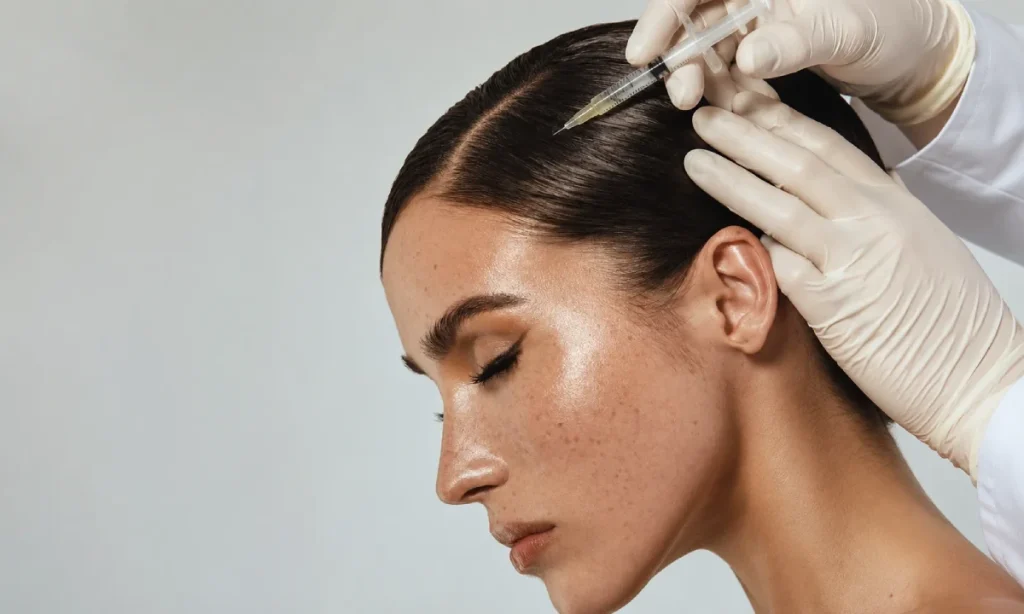
What Is Hair Mesotherapy?
Hair mesotherapy is a minimally invasive cosmetic treatment that involves multiple microinjections into the scalp. These injections deliver biologically active substances directly into the middle layer of the skin (the mesoderm), allowing nutrients to reach hair follicles more effectively than topical products.
The treatment is commonly used to:
- Reduce excessive hair shedding
- Improve scalp circulation
- Stimulate weakened hair follicles
- Strengthen thin and fragile hair
- Increase hair density
- Support recovery after hair transplantation
Unlike oral supplements, which distribute nutrients throughout the body, mesotherapy targets the scalp directly, potentially improving local absorption while minimizing systemic exposure.
What Is a Hair Mesotherapy Cocktail?
A hair mesotherapy cocktail is a specially formulated solution injected into the scalp during treatment. The exact formulation varies depending on the patient’s hair condition, scalp health, age, and underlying cause of hair loss.
A typical cocktail may contain:
- Vitamins (especially B-complex vitamins)
- Amino acids
- Hyaluronic acid
- Trace minerals such as zinc and copper
- Coenzymes
- Antioxidants
- Biomimetic peptides
- Growth-supporting ingredients
Different commercial formulations are designed for specific indications such as androgenetic alopecia, diffuse hair loss, postpartum shedding, or weakened hair following medical treatments.
The best results are achieved when the cocktail is selected based on an individualized medical assessment rather than using the same formula for every patient.
Hair Loss Treatment with Hair Mesotherapy
Hair mesotherapy is most effective when hair follicles remain alive but have become weak or miniaturized. By improving the nutritional environment around the follicles, the treatment may help reduce ongoing shedding and encourage healthier hair production.
Patients often seek mesotherapy for:
- Pattern hair loss
- Diffuse hair thinning
- Stress-related shedding
- Seasonal hair loss
- Nutritional hair deficiencies
- Hair weakening after pregnancy
- Early-stage androgenetic alopecia
The treatment is usually more effective during the early phases of hair loss than in advanced baldness where follicles have permanently disappeared.
Hair Mesotherapy Procedure: Step-by-Step
Hair mesotherapy is typically performed in an outpatient clinic and usually takes between 20 and 40 minutes.
The procedure generally includes:
- Medical consultation and scalp assessment
- Hair loss diagnosis
- Cleansing and disinfecting the scalp
- Application of topical anesthetic if necessary
- Multiple superficial injections using fine needles
- Post-treatment instructions
The injections are placed at regular intervals across affected areas to ensure even distribution of the solution.
Patients can usually return to normal daily activities shortly after the procedure.
Does Hair Mesotherapy Promote Hair Regrowth?
Hair mesotherapy may stimulate new hair growth in selected patients, particularly when follicles are still viable. However, expectations should remain realistic.
The treatment may help:
- Activate dormant follicles
- Increase hair shaft thickness
- Improve scalp circulation
- Reduce miniaturization
- Extend the hair growth phase
Complete regrowth in completely bald areas is unlikely because mesotherapy cannot create new follicles where none remain.
The degree of improvement depends on:
- Cause of hair loss
- Age
- Genetics
- Follicle health
- Treatment consistency
- Lifestyle factors
How Many Hair Mesotherapy Sessions Are Needed?
The number of sessions varies according to individual needs.
A common treatment protocol includes:
- 4–8 initial sessions
- Sessions every 1–2 weeks
- Maintenance treatments every 2–6 months
Patients with chronic hair loss often require periodic maintenance to preserve results.
Visible improvement usually develops gradually over several months.
Hair Mesotherapy After Hair Transplant
Hair mesotherapy is frequently recommended after hair transplantation as an adjunctive treatment.
Potential benefits include:
- Supporting graft survival
- Improving scalp healing
- Nourishing transplanted follicles
- Reducing temporary post-transplant shedding
- Enhancing hair quality
Treatment should only begin after the transplant surgeon confirms that the scalp has healed sufficiently.
Types of Hair Mesotherapy
| Type | Main Purpose | Typical Ingredients |
| Vitamin Mesotherapy | Nutritional support | Vitamins, minerals |
| Peptide Mesotherapy | Follicle stimulation | Biomimetic peptides |
| Hyaluronic Acid Mesotherapy | Scalp hydration | Hyaluronic acid |
| Anti-Hair Loss Mesotherapy | Reduce shedding | Peptides, vitamins, antioxidants |
| Regenerative Mesotherapy | Hair strengthening | Growth-supporting complexes |
| Customized Mesotherapy | Personalized treatment | Tailored ingredient combinations |
Which Areas Are Injected During Hair Mesotherapy?
The injection sites used during hair mesotherapy depend on the patient’s pattern of hair loss, scalp condition, and treatment goals. Rather than injecting the entire scalp randomly, experienced practitioners carefully target areas where hair follicles have become weakened or where thinning is most noticeable. By placing small amounts of the mesotherapy solution directly into affected regions, the treatment aims to improve follicle nutrition, support scalp health, and encourage stronger hair growth.
Frontal Hairline
The frontal hairline is one of the most frequently treated areas, particularly in individuals with early signs of a receding hairline or thinning across the front of the scalp. This region is commonly affected in both men with androgenetic alopecia and women experiencing frontal hair thinning.
Mesotherapy injections along the frontal scalp help deliver nutrients directly to weakened follicles, where they may improve hair strength, reduce ongoing shedding, and support healthier hair production. Early treatment in this area often provides better outcomes because many follicles remain active before significant hair loss develops.
Crown (Vertex)
The crown, also known as the vertex, is another common injection site because it is highly susceptible to pattern hair loss. Hair thinning in this area often progresses gradually, making early intervention especially important.
Mesotherapy injections throughout the crown aim to nourish miniaturized follicles, improve local blood circulation, and enhance the scalp environment needed for healthy hair growth. Patients with mild to moderate thinning in the vertex region often include this area as a primary focus of their treatment plan.
Mid-Scalp
The mid-scalp, located between the frontal hairline and the crown, is frequently treated in patients with diffuse hair thinning rather than isolated bald patches. Reduced density in this region can make the hair appear flatter and less voluminous.
Injecting the mesotherapy solution evenly across the central scalp helps provide consistent nourishment to weakened follicles. The goal is to improve overall hair quality, increase strand thickness, and create a fuller appearance by supporting healthier growth across the entire affected area.
Temporal Regions
The temporal regions, commonly referred to as the temples, are often treated in individuals experiencing recession along the sides of the forehead. Hair loss in this area is particularly common in men but may also occur in women with hormonal or genetic hair thinning.
Because the hairline around the temples plays a major role in facial aesthetics, targeted mesotherapy injections may help strengthen existing follicles, slow further recession, and improve hair density where viable follicles remain. Treatment is typically customized according to the degree of hair loss in each temple.
Diffuse Thinning Areas
Some patients experience generalized thinning across multiple regions of the scalp rather than localized bald spots. In these cases, the physician distributes mesotherapy injections evenly throughout all affected areas to achieve uniform coverage.
This comprehensive approach allows the active ingredients to reach weakened follicles across the scalp, promoting better overall scalp health while reducing widespread hair shedding. Treating diffuse thinning with carefully planned injection patterns helps maximize consistency in hair quality, thickness, and density rather than focusing on a single region.
Benefits of Hair Mesotherapy
Reduces Hair Shedding
Many patients notice gradual reduction in excessive daily hair loss after completing several treatment sessions.
Strengthens Hair Follicles
The injected nutrients may improve follicular metabolism and resilience.
Improves Hair Thickness
Existing hair often appears fuller as shaft diameter increases.
Enhances Scalp Circulation
Improved blood flow helps deliver oxygen and nutrients to growing follicles.
Supports Healthier Hair Growth
By optimizing the scalp environment, mesotherapy may promote stronger, healthier hair production.
Improves Scalp Health
Some patients experience reduced dryness and improved scalp quality.
Complements Other Hair Restoration Treatments
Hair mesotherapy is frequently combined with PRP therapy, topical medications, oral treatments, or hair transplantation as part of a comprehensive treatment plan.
How Long Do Hair Mesotherapy Results Last?
Hair mesotherapy does not provide permanent results.
Its longevity depends on:
- Underlying cause of hair loss
- Genetic predisposition
- Lifestyle
- Hormonal factors
- Maintenance treatments
Many patients maintain improvements for several months after completing the initial treatment course, although ongoing maintenance is often recommended for chronic conditions.
Who Needs Hair Mesotherapy?
Hair mesotherapy may be suitable for individuals experiencing:
- Early-stage hair thinning
- Diffuse hair loss
- Stress-induced shedding
- Postpartum hair loss
- Nutritional hair deficiencies
- Weak, fragile hair
- Hair quality deterioration
- Recovery after hair transplantation
An accurate diagnosis is essential before starting treatment.
Can Hair Mesotherapy Treat Genetic Hair Loss?
Hair mesotherapy cannot permanently cure hereditary hair loss.
However, it may:
- Slow progression
- Improve hair quality
- Delay further thinning
- Enhance the effects of medical treatments
Patients with androgenetic alopecia usually achieve the best outcomes when mesotherapy is combined with evidence-based therapies prescribed by a physician.
What Is the Best Age for Hair Mesotherapy?
There is no fixed age requirement.
Treatment is generally considered for adults who demonstrate clinically diagnosed hair thinning.
Earlier intervention often produces better outcomes because more active follicles remain available for stimulation.
Who Is Not a Good Candidate for Hair Mesotherapy?
Hair mesotherapy may not be appropriate for individuals with:
- Active scalp infections
- Uncontrolled diabetes
- Bleeding disorders
- Severe autoimmune scalp diseases
- Known allergy to treatment ingredients
- Pregnancy (unless specifically approved by a physician)
- Breastfeeding in selected cases
- Active skin inflammation at injection sites
A complete medical history should always be reviewed before treatment.
Aftercare Following Hair Mesotherapy
Proper aftercare helps reduce irritation and supports recovery.
Patients are commonly advised to:
- Avoid washing the hair for 24 hours.
- Refrain from strenuous exercise for 24–48 hours.
- Avoid excessive sweating.
- Protect the scalp from direct sun exposure.
- Avoid scratching the treated area.
- Follow all physician instructions regarding medications and hair products.
Temporary redness and mild tenderness usually resolve within a few days.
Why Does Hair Shedding Sometimes Occur After Hair Mesotherapy?
Some patients notice temporary increased shedding during the early treatment phase.
Possible reasons include:
- Synchronization of the hair growth cycle
- Replacement of weakened hairs with healthier growth
- Natural follicular turnover
This temporary shedding is generally self-limited and differs from progressive hair loss.
Persistent or severe shedding should be evaluated by the treating physician.
Hair Mesotherapy vs PRP Hair Treatment
| Feature | Hair Mesotherapy | PRP Hair Therapy |
| Injection Material | Vitamins, peptides, nutrients | Patient’s own platelet-rich plasma |
| Blood Draw Required | No | Yes |
| Main Goal | Follicle nourishment | Growth factor stimulation |
| Customization | High | Moderate |
| Downtime | Minimal | Minimal |
| Suitable for Combination | Yes | Yes |
Both treatments have distinct mechanisms of action and may be combined in selected patients for comprehensive hair restoration.
What Are the Possible Side Effects of Hair Mesotherapy?
Mild Pain During Injection
Most patients experience only mild discomfort because very fine needles are used.
Temporary Redness
Mild redness at injection sites is common and usually disappears within hours.
Swelling
Minor swelling may occur temporarily after treatment.
Small Bruises
Tiny bruises can develop, particularly in patients with sensitive skin.
Scalp Tenderness
The scalp may feel slightly sore for one or two days.
Allergic Reaction
Although uncommon, allergic reactions may occur in response to certain ingredients within the mesotherapy cocktail.
Infection
Infection is rare when strict sterile techniques are followed but remains a potential risk with any injectable procedure.
Temporary Headache
A small number of patients report mild headaches following treatment, which generally resolve without intervention.