
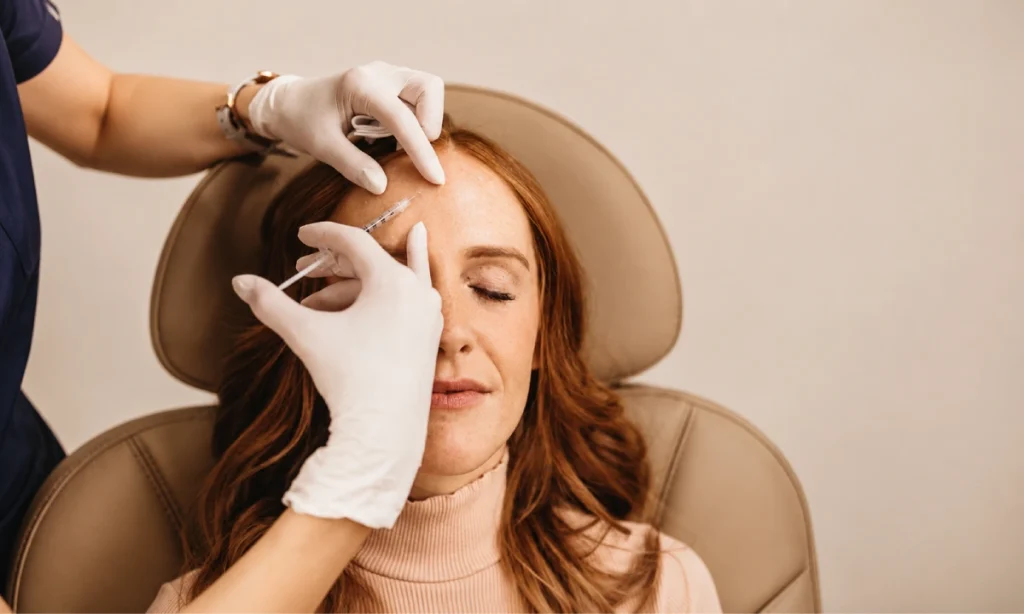
What Is Forehead Botox Injection?
Forehead Botox injection is a non-surgical procedure in which a very small amount of botulinum toxin type A is injected into specific muscles in the forehead area. By temporarily blocking the nerve signal that causes muscle contraction, this substance reduces the movement of the muscles responsible for creating wrinkles. The result is the gradual smoothing of horizontal forehead lines and the prevention of their further deepening.
Contrary to common belief, Botox does not permanently paralyze the muscle; its effect is temporary and reversible, and after a few months, normal muscle function returns. For this reason, the injection is repeated at specific intervals.
The Best Doctor for Forehead Botox Injection
Choosing the right physician is the most important factor in the final outcome of forehead Botox. The forehead area is highly sensitive due to its direct connection to the eyebrows and eyelids, and incorrect injection can lead to brow drooping or an unnatural appearance.
A good doctor for this procedure should have the following qualities:
- Precise knowledge of forehead muscle anatomy and safe injection points
- Sufficient experience with real, verifiable case results
- The ability to design a plan tailored to each person’s facial structure, rather than a fixed template for everyone
- Use of reputable, licensed brands
- Honesty in explaining realistic expectations
Before the injection, an in-person consultation and assessment of the face at rest and in motion are signs of professional work.
How Is Forehead Botox Injected?
The forehead Botox procedure is short and outpatient, usually taking between 10 and 20 minutes. First, the physician identifies the precise injection points by examining muscle movements, and then, using very fine needles, delivers the determined dose superficially into the muscle.
The pain of this procedure is usually minimal and tolerable, and most people describe it as similar to a brief pinch. For those who are sensitive, a topical numbing cream can be used.
Steps of Forehead Botox Injection
The general injection process usually proceeds as follows:
- Initial consultation and review of medical history and the person’s expectations
- Complete cleansing and disinfection of the forehead area
- Marking the injection points based on the muscle movement pattern
- Injecting the appropriate dose at each point
- Providing aftercare recommendations
After the procedure is complete, the person can immediately return to daily activities.
What Are the Benefits of Forehead Botox Injection?
Forehead Botox is more than just a purely cosmetic measure and offers several practical benefits that have made it a popular choice.
Reducing Horizontal Forehead Wrinkles
The main use of Botox is smoothing the horizontal lines that appear on the forehead when raising the eyebrows. By reducing muscle contraction, these lines fade or become less visible, and the skin takes on a smoother appearance.
Preventing Deeper Lines from Forming
Forehead lines become deeper and permanent over time with repeated muscle movements. By reducing these movements, Botox prevents superficial lines from turning into deep structural wrinkles; for this reason, many consider it a preventive measure.
Treating Acne Scars on the Forehead
Although Botox is not the primary treatment for acne scars, in some cases it improves the appearance of minor depressions by reducing muscle movement and tightening the skin, and it is usually used alongside other methods.
Creating a More Natural and Refreshed Appearance
A correct injection with the appropriate dose preserves the face’s natural expression. The goal is not a completely immobile forehead, but rather a calm, more open, and fresher face that shows less fatigue.
Higher Longevity Compared to Other Methods
Compared to creams and topical methods that have a superficial and transient effect, Botox delivers a more tangible result lasting several months, making it cost-effective and efficient.
How Long Does Forehead Botox Last?
The effect of forehead Botox usually lasts between 3 and 6 months. This range depends on several factors, including the body’s metabolism, muscle strength, the person’s level of muscle activity, the Botox brand, and the injected dose.
In initial injections, longevity is usually shorter, but with regular repetition over time, the interval between sessions can increase, as the muscles gradually become accustomed to reduced movement.
Necessary Preparations Before Forehead Botox Injection
Following a few simple points before the injection reduces the likelihood of bruising and complications:
- Avoiding blood-thinning medications such as aspirin and certain supplements (in coordination with your doctor) a few days beforehand
- Avoiding alcohol consumption 24 hours before the injection
- Fully disclosing your medical history, allergies, and medications taken
- Refraining from injection if there is an active skin infection in the forehead area
- Arriving at the session with a clean, makeup-free face
An honest consultation with your doctor about expectations is also an important part of this preparation.
Necessary Aftercare Following Forehead Botox Injection
The first hours and days after the injection play an important role in the final result. Following the recommendations below helps keep the Botox in the correct location.
Washing Your Face After the Injection
It is best to avoid washing or excessive contact with the injection area for the first few hours. After that, gentle washing with lukewarm water without pressure or vigorous massaging is permitted. Avoid rubbing the forehead firmly.
Applying Face Cream After the Injection
Using heavy creams or massaging cream into the skin on the first day is not recommended. Mild moisturizers can be used from the next day with gentle, pressure-free motions.
Applying Makeup After the Injection
It is best to postpone makeup on the forehead area for at least 24 hours to prevent contamination from entering the needle site and to avoid displacing the substance. Makeup should be applied gently and without pressure.
How to Sleep After the Injection
For the first few hours, avoid lying down and prolonged bending. On the first night, it is best to sleep on your back with your head slightly elevated so that no pressure is placed on the injection area and the substance settles in place.
Coloring Your Hair After the Injection
Coloring your hair is not prohibited in itself, but due to heat, chemicals, and possible pressure on the forehead, it is recommended to wait a few days until the Botox is fully settled.
Getting to Know the Forehead Botox Injection Points
Injection points on the forehead are selected based on the path of the frontalis muscle (the main muscle responsible for raising the eyebrows and creating horizontal lines). The physician usually marks several points in symmetrical rows across the forehead to create a uniform and balanced effect.
Determining these points is entirely individualized and depends on each person’s forehead shape, its height, the wrinkle pattern, and the position of the eyebrows. Maintaining an appropriate distance from the brow line is very important, because injecting too close to the eyebrow can lead to drooping.
Reviewing the Different Brands of Forehead Botox
There are several brands of botulinum toxin on the market that differ in quality, purity, and speed of effect. Among the most well-known are:
- American Botox (Botox/Allergan): One of the most reputable and long-established brands with stable results
- Dysport: Known for greater diffusion and sometimes a faster onset of effect
- Xeomin: Free of additional proteins, with a lower likelihood of long-term bodily resistance
- Korean brands and other manufacturers: Diverse, with varying quality and prices
The choice of brand should be made based on the physician’s judgment, facial structure, and budget; more important than the brand are the authenticity of the product and the skill of the injector.
Who Is Forehead Botox Recommended For?
Forehead Botox is suitable for people whose horizontal or frown lines are forming or deepening and who are seeking a calmer appearance. People who do not yet have deep structural wrinkles can also use it as a preventive method.
Forehead Botox Injection for Men
Men’s foreheads usually have stronger, thicker muscles, so a higher dose is often required. In men, the goal is usually to maintain a masculine and natural appearance rather than to completely smooth the forehead; for this reason, the injection is designed with particular finesse.
Forehead Botox Injection for Women
In women, in addition to smoothing the lines, maintaining or slightly raising the arch of the eyebrows is often considered. The dose is usually adjusted to be milder to preserve the natural and feminine appearance of the face.
For Whom Is Forehead Botox Prohibited?
Despite its relative safety, forehead Botox is not suitable for everyone. This procedure is not recommended in the following cases:
- Pregnant or breastfeeding women
- People with neuromuscular diseases such as myasthenia gravis
- A known allergy to botulinum toxin or its components
- An active skin infection or lesion in the injection area
- Blood-clotting disorders, which must be evaluated in coordination with a physician
Forehead Botox During Breastfeeding
Due to the lack of sufficient and conclusive studies on the safety of Botox during breastfeeding, most physicians refrain from performing it during this period. The general recommendation is to wait until the end of breastfeeding for the injection; this cautious approach is intended to protect the health of both mother and child.
What Are the Possible Side Effects of Forehead Botox?
When performed by a specialist, forehead Botox is a relatively safe procedure, but like any medical measure, it may have temporary and mild side effects that usually resolve on their own.
Forehead Itching
Some people experience mild itching at the site after the injection, which is usually transient. If it persists or is severe, you should consult your doctor to rule out an allergic reaction.
Pain in the Forehead Area
Sensitivity or mild pain at the needle site is normal and usually subsides within a few hours to a day. This pain usually does not require any specific painkiller.
Forehead Swelling
Minor swelling or redness at the injection points is common in the first hours and decreases quickly. Applying a mild cold compress can be helpful.
Heaviness and Headache
In the first few days, some people report a feeling of forehead heaviness or a mild headache, which is temporary and usually resolves after the muscles adapt to the new condition.