
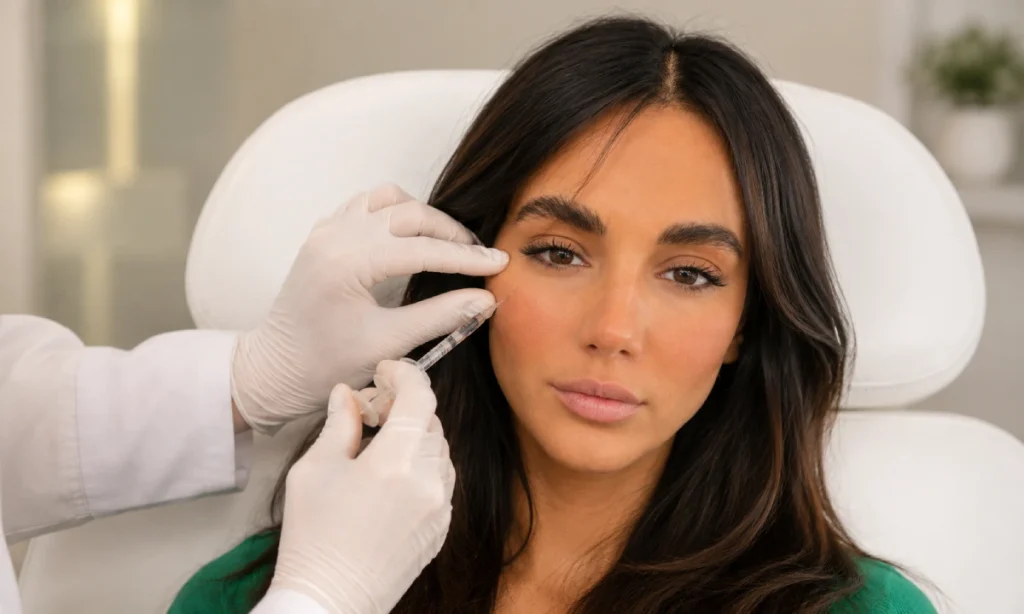
What Is Under Eye Mesogel?
Under eye mesogel is a broad aesthetic term used for injectable products that improve skin hydration, elasticity, texture, and overall quality around the eyes. It is often described as a skin booster or biorevitalisation treatment rather than a conventional filler.
“Mesogel” is not one standardised medical substance. Different clinics may use the term for products containing:
- Non-cross-linked or lightly stabilised hyaluronic acid
- Amino acids
- Peptides
- Polynucleotides
- Antioxidants
- Other skin-supporting compounds
These products are injected in small amounts into carefully selected layers of the under-eye skin. The intention is usually to improve the condition of the tissue rather than to add visible projection or reshape the tear trough.
This distinction matters. A dermal filler is generally selected to replace volume or support facial structure. Under eye mesogel is more appropriate when the main concern is thinness, dehydration, early crepiness, dullness, or fine superficial lines.
Product definitions, licensed indications, and approved injection areas vary between countries. Some under-eye applications may therefore be considered off-label, even when they are commonly performed in aesthetic practice. Patients should be told which product is being used, why it has been selected, and whether its planned use is covered by the manufacturer’s approved indication.
What Skin Concerns Can Under Eye Mesogel Improve?
Under eye mesogel may improve skin quality when the problem originates primarily within the skin itself. It is less effective when the concern is caused by significant fat prolapse, deep volume loss, prominent pigmentation, allergies, vascular congestion, or skeletal anatomy.
Dark Circles
Dark circles do not have one universal cause. They may result from:
- Thin skin that reveals underlying blood vessels
- Dehydration and reduced light reflection
- Tear trough shadowing
- Brown pigmentation
- Post-inflammatory changes
- Allergies or chronic eye rubbing
- Visible veins
- Genetics
- Sleep deprivation or lifestyle factors
Mesogel may make the eye area appear brighter when dark circles are partly related to thin, dehydrated, dull, or crepey skin. Better hydration and gradual improvement in dermal quality can help the surface reflect light more evenly.
It is unlikely to completely remove genetically dark skin, deep tear trough shadows, prominent veins, or pigment caused by melanin. Brown pigmentation may require skincare, chemical peels, selected laser treatments, sun protection, or treatment of an underlying inflammatory condition. A deep hollow may respond better to carefully selected tear trough filler or midface support.
Patients should therefore be cautious of claims that one injectable can permanently “erase” all dark circles.
Fine Lines
Fine lines under the eyes can develop as collagen levels decline, skin becomes drier, and repeated facial expressions gradually crease the tissue. Sun exposure and smoking may accelerate these changes.
Mesogel can soften fine, superficial lines by improving hydration and supporting the quality of the dermal environment. Some formulations are intended to stimulate fibroblast activity or support collagen and elastin production, although the strength of evidence varies between products.
It does not paralyse muscles like Botox. It is also not a substitute for laser resurfacing when lines are deeply etched or associated with substantial sun damage.
Dehydrated Skin
The skin around the eyes contains fewer sebaceous glands than many other facial areas and is especially vulnerable to dryness. Dubai’s air conditioning, heat, sun exposure, travel, and inconsistent hydration may make this problem more noticeable.
Hyaluronic acid-based skin boosters attract and retain water within the treated tissue. This can make the skin look smoother and less crumpled. Results are usually subtle and should resemble healthier skin rather than visible fullness.
Persistent dryness should still be assessed carefully. Eczema, contact dermatitis, inappropriate skincare, retinoid irritation, allergies, and excessive cleansing can all affect the eye area and may need medical management before injections are considered.
Crepey Under Eye Skin
Crepey skin appears thin, finely wrinkled, and less elastic. It may be most noticeable when smiling or applying concealer.
Under eye mesogel may help mild to moderate crepiness by improving hydration and encouraging gradual skin remodelling. Polynucleotide and hyaluronic acid-based injectables have both been studied for periocular rejuvenation, with research suggesting potential improvement in wrinkles, hydration, texture, and patient-reported appearance. However, protocols and products remain variable, and larger high-quality studies are still needed.
Severe skin laxity or marked lower-eyelid excess is unlikely to respond sufficiently to injectable skin boosters alone. In these cases, energy-based treatments, resurfacing, or an oculoplastic assessment may be more appropriate.
Who Is a Good Candidate for Under Eye Mesogel?
A suitable candidate generally has realistic expectations and wants gradual improvement in skin quality rather than dramatic volume correction.
Under eye mesogel may be considered for adults with:
- Mild dark circles linked to thin or dehydrated skin
- Early fine lines
- Crepey texture
- Dullness around the eyes
- Reduced elasticity
- Mild under-eye ageing without severe bags
- A preference for subtle, natural-looking rejuvenation
- Skin that does not require significant structural filling
You may not be a suitable candidate if you have:
- Active infection, cold sores, or inflamed skin near the eyes
- Uncontrolled eczema or dermatitis
- Significant lower-eyelid bags
- Severe fluid retention or malar oedema
- A history of problematic swelling after under-eye injections
- Known allergy to a product ingredient
- A bleeding disorder or poorly controlled medical condition
- Pregnancy or breastfeeding
- Unrealistic expectations
- A need for surgical correction rather than skin improvement
People taking anticoagulants, antiplatelet medicines, or supplements that affect bleeding may bruise more easily. Prescribed medication should never be stopped without approval from the clinician who manages it.
Patients younger than 18 are not routine candidates for elective injectable rejuvenation. Dark circles in teenagers are often related to genetics, allergies, pigmentation, lifestyle, or natural anatomy and should be assessed conservatively.
How Does Under Eye Mesogel Work?
Under eye mesogel works differently depending on its active ingredients.
Hyaluronic acid-based products primarily improve hydration by binding water within the extracellular matrix. This may temporarily enhance smoothness, elasticity, and light reflection.
Amino acid formulations are intended to provide building blocks associated with dermal repair and collagen-related processes. Polynucleotides are purified DNA fragments used as regenerative injectables. Emerging clinical research has examined their effect on hydration, elasticity, fine lines, and periocular appearance, although evidence is still developing and products should not be treated as interchangeable.
The procedure also creates controlled micro-injuries through needle entry. This may contribute to a local healing response, although the injected formulation is the main therapeutic component.
Results are not immediate in the same way as volumising filler. Initial hydration may be noticed relatively early, while textural improvement usually develops progressively over several weeks.
How Is Under Eye Mesogel Performed?
Treatment should be carried out in a regulated clinical setting by a qualified medical practitioner with detailed knowledge of periocular anatomy.
Consultation and Skin Assessment
The consultation is the most important stage because “dark circles” may represent several different conditions.
Dr. Ali will typically assess:
- Skin thickness and texture
- Tear trough depth
- Pigmentation
- Visible blood vessels
- Lower-eyelid fat pads
- Fluid retention
- Midface support
- Previous filler or injectable treatments
- Facial asymmetry
- Medical history
- Medication and allergy history
- The patient’s desired result
Photographs may be taken under consistent lighting. The assessment should determine whether mesogel is appropriate or whether filler, PRP, skincare, laser treatment, allergy management, or no procedure would be safer.
Patients should disclose previous tear trough filler, even if it was injected several years earlier. Hyaluronic acid filler can sometimes remain in the tissue longer than expected, and additional injections may worsen puffiness.
Injection Technique
After cleansing the skin, a topical anaesthetic may be applied. Some products also contain lidocaine.
The selected mesogel may be placed using a fine needle, micro-papule technique, serial punctures, or another product-specific method. The injection depth and quantity depend on the formulation, skin thickness, and treatment objective.
Small raised bumps may be visible immediately after treatment. These usually settle as the material disperses and swelling decreases. The practitioner should avoid excessive volume because the under-eye area has limited space and is prone to fluid accumulation.
A cannula may be appropriate for some injectable procedures, but it does not eliminate risk. Technique must be selected according to the product and anatomy rather than used as a guarantee of safety.
Treatment Duration
The injection stage commonly takes around 15 to 30 minutes. A full appointment may take 30 to 60 minutes when consultation, photography, cleansing, anaesthetic, and aftercare are included.
The number of sessions varies. Many protocols involve two to four initial treatments spaced approximately two to four weeks apart, followed by maintenance. This is not universal; the correct schedule depends on the specific product and individual response.
Which Mesogel Products Are Used for Under Eye Rejuvenation?
No single product is ideal for every patient. Formulation, injection behaviour, swelling tendency, regulatory status, and the patient’s anatomy all influence selection.
Jalupro
Jalupro products combine hyaluronic acid with amino acids. Different versions have different concentrations and intended treatment profiles.
For the eye area, practitioners may consider formulations designed for delicate tissue or periocular rejuvenation. The aim is generally to improve hydration, fine lines, skin texture, and tired-looking under-eye skin rather than to create major volume.
Jalupro is not one uniform product, so patients should ask which version will be injected. A formulation suitable for broader facial treatment may not necessarily be the best choice close to the lower eyelid.
Sunekos
Sunekos combines hyaluronic acid with a patented mixture of amino acids. It is commonly used in aesthetic practice to target fine lines, dehydration, and reduced elasticity, including around the eyes.
Treatment is usually delivered as a course rather than a one-off injection. The under-eye area may appear temporarily puffy or show small injection marks after each session.
Sunekos may suit patients whose main goal is gradual skin-quality improvement. It will not reliably correct a deep tear trough in the same way as structural filler.
Nucleofill
Nucleofill is a polynucleotide-based injectable range. Polynucleotides are used for biostimulation and skin-quality improvement rather than conventional volumisation.
Periocular polynucleotide treatment may be considered for thin, crepey, or environmentally stressed skin. Published research on polynucleotide injections suggests potential benefits for fine lines and periocular rejuvenation, but evidence quality and treatment protocols vary.
Patients with fish allergies should inform their practitioner because some polynucleotide products are derived from salmon or trout sources. Product-specific advice must be followed.
Profhilo
Profhilo is a stabilised hybrid cooperative hyaluronic acid product designed for tissue remodelling and hydration. It is not a traditional volumising filler.
Standard Profhilo protocols are more commonly associated with defined injection points on areas such as the face and neck. Use directly beneath the eyes requires particular caution because the product spreads through tissue and may contribute to unwanted swelling in patients who are prone to oedema.
Some clinicians may choose a Profhilo product specifically developed for certain anatomical areas or may avoid direct lower-eyelid treatment altogether. The decision must be based on the exact product, approved indication, anatomy, and practitioner experience—not simply the familiarity of the brand.
Benefits of Under Eye Mesogel
Potential benefits include:
- Improved skin hydration
- Softer superficial lines
- Smoother texture
- Reduced crepey appearance
- Gradual improvement in elasticity
- Fresher-looking under-eyes
- Minimal or no intentional volumisation
- A natural result that develops progressively
- Shorter recovery than many resurfacing procedures
- Compatibility with personalised combination plans
The key benefit is subtlety. Mesogel aims to make the skin look healthier rather than noticeably filled.
Limitations are equally important. It cannot guarantee the removal of dark circles, lift prominent bags, erase deep wrinkles, or permanently change genetic pigmentation. Results also vary according to age, skin condition, lifestyle, product selection, treatment course, and injection technique.
Under Eye Mesogel Before and After
Before-and-after changes are generally more refined than those seen with tear trough filler.
After a suitable treatment course, patients may notice:
- More hydrated skin
- Less visible crepiness
- Smoother makeup application
- Softer fine lines
- A brighter appearance in some lighting
- Improved texture
- Reduced tiredness caused by skin dullness
The eye area should not appear overfilled or structurally different.
Early photographs may be misleading if taken while the tissue is still swollen. Meaningful comparison should use the same lighting, camera distance, facial expression, and head position, ideally several weeks after the treatment course.
Results may be limited when darkness is caused by deep shadowing, pigmentation, prominent veins, or eye bags. A responsible consultation should predict this before treatment rather than after an unsatisfactory result.
Recovery and Aftercare Following Under Eye Mesogel
Downtime is usually limited, but the under-eye area bruises and swells easily. Scheduling treatment immediately before a wedding, flight, photoshoot, or major event is not advisable.
Recovery Timeline
Immediately after treatment: Small bumps, redness, tenderness, or mild swelling may be visible.
First 24 to 48 hours: Puffiness and injection marks may become more noticeable, especially in the morning.
Days two to seven: Most minor swelling and bruising gradually settle. Some patients recover faster; others may bruise for more than a week.
Following weeks: Hydration and texture may improve progressively. Regenerative products generally require time and repeated sessions.
Persistent or worsening swelling should be assessed, particularly if it is one-sided, painful, hot, associated with colour change, or affecting vision.
Aftercare Instructions
After treatment:
- Do not rub, press, or massage the area unless specifically instructed.
- Avoid makeup over injection points for the period advised by the practitioner.
- Avoid strenuous exercise for approximately 24 hours.
- Avoid saunas, steam rooms, and excessive heat for 24 to 48 hours.
- Avoid alcohol on the day of treatment if it increases flushing or bruising.
- Sleep with the head slightly elevated if swelling occurs.
- Use a clean, cool compress without applying heavy pressure.
- Continue gentle sun protection.
- Avoid introducing strong acids, retinoids, or irritating eye products until the skin has settled.
- Follow the clinic’s product-specific instructions.
Patients should seek urgent medical assessment for severe pain, blanching, dusky or mottled skin, rapidly increasing swelling, visual disturbance, severe headache, or neurological symptoms.
How Long Does Under Eye Mesogel Last?
Results commonly last several months, but there is no universal duration.
A typical improvement may remain noticeable for approximately four to nine months after an initial treatment course. Some patients schedule maintenance earlier, while others retain benefits for longer.
Duration depends on:
- Product formulation
- Number of initial sessions
- Skin age and thickness
- Sun exposure
- Smoking
- Stress and sleep
- General health
- Skincare routine
- Dubai’s environmental conditions
- Individual metabolism
- Ongoing collagen loss
Hydration benefits may become apparent before regenerative changes. Maintenance should be based on clinical need rather than automatically repeating injections at the shortest possible interval.
Risks and Side Effects of Under Eye Mesogel
All injections carry risk. The lower eyelid is a delicate, highly vascular area close to the eye, and even non-volumising products require careful technique.
Common Side Effects
Temporary effects may include:
- Redness
- Swelling
- Bruising
- Tenderness
- Itching
- Small raised bumps
- Unevenness during early healing
- Mild discomfort
- Temporary dryness or sensitivity
These effects are usually self-limiting. Bruising may be more visible in people with thin skin or those taking medication that affects clotting.
Rare Complications
Less common complications may include:
- Infection
- Prolonged oedema
- Persistent lumps or nodules
- Inflammatory reactions
- Allergic reactions
- Product visibility beneath thin skin
- Asymmetry
- Persistent discolouration
- Reactivation of certain skin conditions
- Vascular compromise
Accidental injection into a blood vessel is the most serious recognised risk associated with injectable dermal filler procedures. Depending on the product and location, vascular occlusion can potentially cause skin injury, tissue loss, stroke, or blindness. Although such events are rare, they may be permanent and require immediate management.
Not every mesogel behaves like a conventional cross-linked filler, but describing any periocular injection as risk-free would be inaccurate.
Under Eye Mesogel vs Tear Trough Filler
Under eye mesogel and tear trough filler solve different problems.
| Feature | Under Eye Mesogel | Tear Trough Filler |
| Primary purpose | Improve skin quality | Replace volume and reduce hollowing |
| Best for | Dehydration, fine lines, crepiness | Selected tear trough depressions |
| Volume added | Minimal or none | Yes |
| Result development | Gradual | Often visible immediately |
| Typical treatment plan | Course of sessions | Often one session with review |
| Ability to correct deep hollows | Limited | Greater |
| Swelling risk | Present | Can be significant or persistent |
| Reversibility | Depends on formulation | HA filler may be dissolved with hyaluronidase |
| Main limitation | Cannot correct major volume loss | Can worsen bags or oedema in unsuitable patients |
Mesogel is often preferable when the skin is thin and crepey but there is little structural hollowing. Tear trough filler may be considered when true volume loss creates a defined groove.
Filler is not appropriate for everyone. Patients with prominent bags, poor lymphatic drainage, malar oedema, or a tendency to prolonged swelling may look worse after tear trough filling. Serious vascular complications, although uncommon, are also possible.
Under Eye Mesogel vs PRP
PRP, or platelet-rich plasma, is prepared from the patient’s own blood. After centrifugation, a platelet-concentrated component is injected or used alongside another treatment to support tissue repair.
| Feature | Under Eye Mesogel | PRP |
| Material | Manufactured injectable formulation | Autologous blood-derived plasma |
| Main objective | Hydration and skin-quality improvement | Regenerative signalling and tissue support |
| Consistency | Standardised by product | Varies with preparation and patient factors |
| Allergy risk | Product-related reactions are possible | Low allergy risk to the patient’s own plasma |
| Downtime | Swelling and bruising | Swelling and bruising |
| Sessions | Usually a course | Usually a course |
| Best choice | Depends on skin concern and product | Depends on blood quality and treatment goal |
Mesogel may be preferred when hydration is a priority and the practitioner wants a predictable, product-specific formulation. PRP may appeal to patients who prefer an autologous treatment.
Neither option is universally better. A 2025 systematic review found that PRP and PRF protocols for periorbital rejuvenation remain heterogeneous, making direct comparisons difficult.
Can Under Eye Mesogel Be Combined with Other Treatments?
Combination treatment may be useful because dark circles and under-eye ageing often have several causes. Procedures should be staged thoughtfully to avoid excessive inflammation, swelling, or overlapping complications.
Tear Trough Filler
Mesogel may improve surface quality, while filler addresses selected volume deficits. They should not automatically be injected together.
In some patients, improving midface support or tear trough anatomy first provides the greatest visible change. In others, treating skin quality without filler is safer. Existing filler should be assessed before adding any new injectable.
Skin Boosters
Under eye mesogel can form part of a wider skin-booster plan for the face, neck, or décolletage. Different products may be selected for different anatomical areas.
Using multiple injectables does not necessarily create a better result. The treatment plan should minimise unnecessary product exposure and respect each manufacturer’s instructions.
PRP
PRP and mesogel may be staged in patients who need both hydration and regenerative support. Evidence for combined facial rejuvenation approaches is promising but does not establish one universal protocol.
Full Face Rejuvenation
A full-face plan may include skin boosters, Botox, filler, laser treatment, microneedling, skincare, or tightening procedures.
Treating only the under-eyes can sometimes create imbalance if midface volume loss, cheek descent, pigmentation, or dynamic crow’s feet are the main contributors. Dr. Ali may recommend prioritising another area or using fewer treatments than the patient initially expected.
Under Eye Mesogel Cost in Dubai
The cost of under eye mesogel in Dubai commonly ranges from approximately AED 700 to AED 2,500 per session, although certain premium formulations or specialist treatments may cost more.
Current published Dubai prices vary considerably. Examples include Jalupro treatments starting below AED 1,000 at some clinics, Jalupro Young Eye around AED 1,200 to AED 1,500, and Sunekos commonly advertised between approximately AED 1,100 and AED 2,200 per session. Promotional prices may not include the same product quantity, practitioner level, follow-up, or treatment plan.
The final price depends on:
- The exact brand and formulation
- Product quantity
- Number of sessions
- Practitioner qualifications
- Clinic standards
- Whether treatment is limited to the eyes
- Whether combination treatment is required
- Follow-up and review arrangements
Patients should compare the exact product and treatment protocol, not only the advertised starting price. A very low fee may reflect a promotion, smaller quantity, different formulation, or a non-comparable service.
Why Choose Dr. Ali for Under Eye Mesogel in Dubai?
The quality of an under-eye result depends less on choosing the most fashionable product and more on correct diagnosis, conservative planning, and detailed knowledge of periocular anatomy.
Dr. Ali’s assessment focuses on identifying the actual cause of the concern. Thin skin, pigmentation, dehydration, hollowness, eye bags, vascular visibility, and fluid retention may all produce a tired appearance, but they should not be treated in the same way.
A personalised approach may include:
- Determining whether mesogel is genuinely suitable
- Selecting a formulation appropriate for delicate under-eye tissue
- Reviewing previous fillers and injectable treatments
- Using conservative product quantities
- Explaining realistic limitations
- Avoiding filler when swelling risk is high
- Planning staged combination treatment when necessary
- Providing clear aftercare and complication advice
- Monitoring the result rather than over-treating early
The objective is not to promise perfect or permanently bright under-eyes. It is to achieve a medically appropriate improvement while preserving natural expression and minimising avoidable risk.